
By Shelby Huffaker, MPH | Chair, San Diego Chapter of Americans for Safe Access
On January 14, 2026, the County of San Diego held a public hearing on its Draft Socially Equitable Cannabis Program. The hearing sought Board direction on three key policy areas:
- Whether to align sensitive use categories and buffer zones with state requirements, or to add additional sensitive use categories, increase buffer zones, and impose restrictions on outdoor cultivation
- Whether to allow cannabis consumption lounges and temporary events
- Whether to continue developing the Community Equity Contribution Program (CECP), which would allow social equity operators to receive tax rebates and grants for providing a benefit to their local community
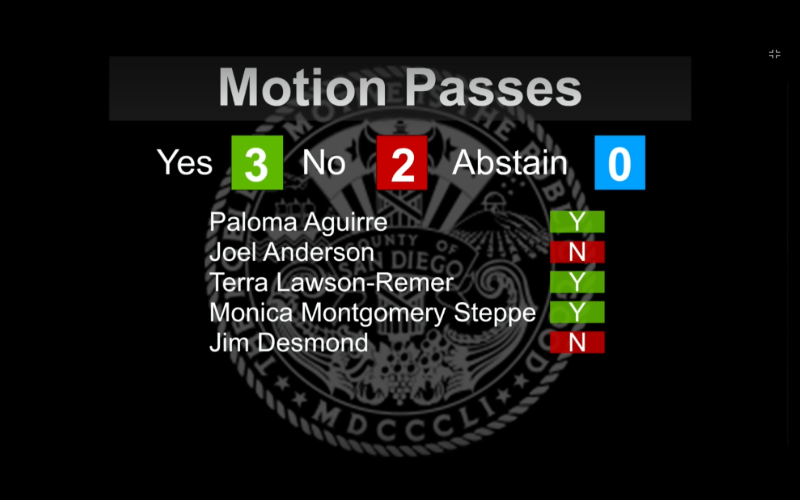
The Board ultimately voted 3–2 (Lawson-Remer, Montgomery Steppe, Aguirre in favor) to advance Option A across all three decision points, marking a significant step toward expanding safe access and cannabis social equity in the unincorporated county.
The hearing was well-attended. Board members of the San Diego chapter of Americans for Safe Access—including Chair Shelby Huffaker, Treasurer Daniel Schadler, and Guest Member MEgain Erlise—provided testimony urging the County to adopt Option A across all three decision points to expand equitable and safe access for medical cannabis patients and consumers. Watch San Diego ASA’s testimony and read our written comment to the Board of Supervisors below.
San Diego ASA Public Comment on Cannabis EIR Decision Points
Dear Members of the Board of Supervisors,
We are the San Diego chapter of Americans for Safe Access, part of a national non-profit comprised of medical cannabis patients, caregivers, medical professionals, researchers, and stakeholders working to advance safe access to cannabis for therapeutic use and research. We appreciate the opportunity to provide feedback on several decision points related to the County’s draft cannabis Environmental Impact Report (EIR).
Decision Point #1: Land Use
POSITION: Option A (Align with State Standards)
Ensures equitable and sufficient access
A wide range of national and international health agencies now recognize the therapeutic potential of medical cannabis. Aligning County rules with minimum state buffer distances from sensitive uses will expand safe access—especially for medical cannabis patients and underserved communities.
In California, nearly 5% of residents (1.9 million people) are registered medical cannabis patients. Applying that rate locally suggests roughly 25,000 patients in the unincorporated County alone. For these residents, cannabis should be as accessible as traditional medications. By comparison, over half of Americans live within one mile of a pharmacy, and two-thirds live within two miles.
Expanding buffer distances or adding additional sensitive uses reduces access in precisely the areas where patients need it most. Including residential care facilities as sensitive uses would disproportionately burden populations most likely to benefit from cannabis therapeutically—older adults, palliative care patients, and those with limited mobility—while conflicting with state law, which requires such facilities to permit medical cannabis use purchased by patients.
Necessary for the viability of the Socially Equitable Cannabis Program (SECP)
Aligning with state zoning standards is also essential to ensuring the viability of the County’s Socially Equitable Cannabis Program. A 1,000-foot buffer would dramatically shrink the number of viable parcels for operators, especially when combined with overly broad definitions of sensitive uses. Under current County criteria, “parks” can include trails, easements, community centers, open space preserves, ecological reserves, and even County-managed landmark sites or monuments—effectively excluding large geographic areas from eligibility.
Similarly, categorizing places of worship as sensitive uses is problematic because they can be established in private residences, quickly opened by opponents to block licensing, and not all faith traditions object to cannabis, with some considering it sacred.
For equity operators with limited capital and fewer opportunities to relocate or litigate, such restrictions would be devastating. Aligning with state standards—or at a minimum, narrowing definitions of sensitive use additions—is necessary to uphold the County’s stated equity commitments.
Supports public health and economic goals
Strengthening the regulated market advances the County’s public health goals. California’s unregulated market still dominates sales; adopting state zoning standards expands the legal market and reduces reliance on untested, unregulated products.
Research consistently shows that legalization does not increase youth cannabis use and may reduce it by regulating sales and enforcing age limits. Even Nora Volkow, Director of the National Institute on Drug Abuse, has acknowledged that youth use has not risen due to legalization. A state-commissioned compliance study found that 100% of licensed retailers verified age at the point of sale.
Research also indicates that cannabis can reduce consumption of more harmful substances, including opioids and alcohol. This carries significant public health and fiscal benefits—lower healthcare and treatment costs, coupled with tax revenue from the regulated market.
Finally, expanding retail access in areas where people live and work shortens driving distances, supports active and public transportation, and may reduce impaired driving relative to long trips to distant retailers.
For all of these reasons, we strongly support Option A: Aligning zoning requirements with state standards.
Decision Point #2: Regulations on Temporary Events & Consumption Lounges
POSITION: Option A (Retain Temporary Cannabis Events and Onsite Consumption in SECP for Further Consideration)
Temporary cannabis events and onsite consumption lounges promote responsible use by providing lawful alternatives to public consumption. These spaces are particularly important for patients and consumers who cannot consume at home, including renters, parents of young children, and individuals living in multi-unit housing or under restrictive HOA/landlord policies. Because renters are more likely to be lower income, access to consumption spaces is also an equity issue. It is inequitable for only homeowners—especially those affluent enough to own single-family homes—to have legal spaces to consume cannabis, while renters lack any such option.
In addition, modern cannabis consumption facilities employ highly effective odor-mitigation systems and pose no greater land-use compatibility challenges than alcohol-serving establishments in the unincorporated area; in fact, cannabis’ superior safety profile arguably makes such facilities more compatible. Retaining these elements for further SECP development is therefore critical.
Decision Point #3: Community Equity Contribution Program (CECP)
POSITION: Option A (Continue to develop the CECP and include in final ordinance return in Summer 2026)
The Community Equity Contribution Program is a cornerstone of a meaningful and functional SECP. California’s cannabis industry is characterized by high startup and operating costs, which routinely push out small businesses and equity operators—particularly farmers. The CECP would provide essential tax incentives, grants, and supports that allow equity applicants not only to enter the market, but to remain competitive over time.
Importantly, CECP investments would extend beyond individual businesses, fostering long-term community development and economic opportunity in communities in the unincorporated county. Continuing to develop the CECP is therefore necessary to uphold the County’s stated equity commitments.
Thank you for your consideration and for your ongoing work to advance an equitable, effective, and public health-oriented approach to cannabis regulation in San Diego County.
Sincerely,
The San Diego Chapter of Americans for Safe Access
About the San Diego Chapter of Americans for Safe Access
The San Diego Chapter of Americans for Safe Access (ASA) is the local chapter of the largest national member-based organization of patients, medical professionals, scientists, and concerned citizens promoting safe and legal access to cannabis for therapeutic use and research. With over 150,000 active members with chapters and affiliates in all 50 states, ASA works to change local and federal policy to meet the immediate needs of patients as well as create long-term strategies for safe access and programs that encourage research.


